

GST Billing Software for Small Business: Complete 2026 Guide
GST compliance is an important part of running a business in India. Small businesses, retailers, wholesalers, distributors, and service providers need accurate billing, proper tax calculations,…
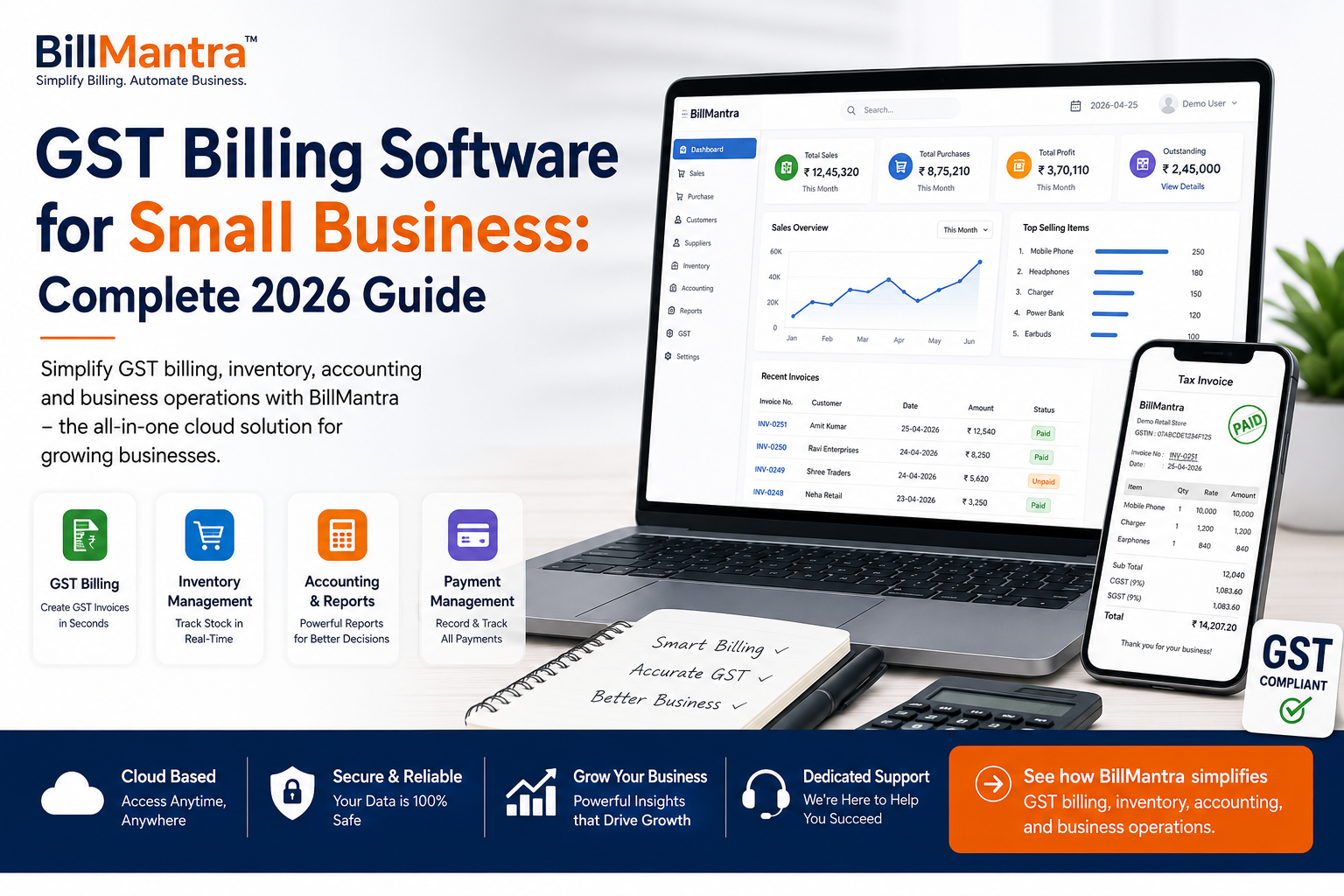
GST compliance is an important part of running a business in India. Small businesses, retailers, wholesalers, distributors, and service providers need accurate billing, proper tax calculations, organized records, and efficient financial management to operate smoothly.
As businesses grow, managing GST invoices manually or through spreadsheets can become time-consuming and difficult. Errors in tax calculations, missing invoice details, incorrect records, and delayed reporting can create unnecessary complications.
This is where GST Billing Software can make a significant difference. Modern GST billing software helps businesses create professional invoices, calculate applicable taxes, manage payments, track inventory, maintain accounting records, and generate useful business reports from one platform.
For small businesses, choosing the right software is not only about creating invoices. The ideal solution should simplify daily operations while supporting business growth.
BillMantra is a cloud-based billing, accounting, inventory, and GST management solution designed for Indian SMEs, retailers, wholesalers, distributors, manufacturers, and service businesses.
In this complete 2026 guide, we will explain what GST Billing Software is, why businesses need it, which features you should look for, how it can simplify GST billing, and how BillMantra can help businesses manage billing, inventory, accounting, payments, and other business operations efficiently.
Table of Contents
- What Is GST Billing Software?
- Why Small Businesses Need GST Billing Software in 2026
- How GST Billing Software Simplifies GST Compliance
- Essential Features of GST Billing Software
- Benefits of GST Billing Software for Small Businesses
- Common GST Billing Challenges Faced by Businesses
- GST Billing Software for Different Types of Businesses
- Cloud-Based GST Billing Software vs Traditional Software
- How to Choose the Best GST Billing Software
- Why BillMantra Is a Smart Choice for Indian Businesses
- How BillMantra Simplifies GST Billing
- BillMantra for Retail Businesses
- BillMantra for Wholesalers and Distributors
- BillMantra for Service Businesses
- GST Billing Software and Inventory Management
- GST Billing Software and Accounting
- Practical Business Example
- Common Mistakes to Avoid
- GST Billing Software Checklist for 2026
- Frequently Asked Questions
- Conclusion
- Call to Action
What Is GST Billing Software?
GST Billing Software is a digital business solution that helps businesses create GST-compliant invoices and manage billing-related activities more efficiently.
Instead of calculating taxes manually and maintaining separate records, businesses can use software to automate many routine billing activities.
A complete GST billing system can help businesses manage:
- GST invoices
- Quotations
- Delivery challans
- Credit notes
- Debit notes
- Sales returns
- Purchase records
- Customer information
- Supplier information
- GSTIN details
- HSN and SAC information
- Payment records
- Inventory
- GST reports
- Accounting records
- Business reports
For businesses that handle a large number of transactions, automation can save significant time and reduce repetitive work.
A modern GST Billing Software for Small Business should ideally connect billing with inventory, accounting, purchases, payments, and reporting.
This gives business owners better visibility into their daily operations.
Why Small Businesses Need GST Billing Software in 2026
Small businesses often operate with limited staff and resources. Owners may have to manage sales, billing, inventory, purchasing, payments, accounting, and customer relationships at the same time.
As transaction volumes increase, manual processes become harder to manage.
Faster Invoice Generation
Creating invoices manually can take several minutes for every transaction.
With GST billing software, businesses can store product and customer information and generate invoices much faster.
This is especially useful for retail businesses that handle multiple customers throughout the day.
Automatic GST Calculation
Manual GST calculations can result in mistakes.
GST billing software can automate tax calculations based on the information configured in the system.
This helps reduce calculation errors and makes the billing process more consistent.
Better Record Management
Digital records are easier to search, organize, and review.
Instead of searching through physical files or multiple spreadsheets, businesses can find invoices and transaction information through the software.
Improved Inventory Control
For businesses selling physical products, billing and inventory are closely connected.
When a sale is recorded, inventory should also be updated.
Integrated software can help businesses maintain more accurate stock records.
Better Business Reporting
Business owners need more than invoices.
They need to understand:
- Total sales
- Purchases
- Expenses
- Outstanding payments
- Inventory
- Profit and loss
- Customer balances
- Supplier balances
Integrated software can bring these details together through business reports.
How GST Billing Software Simplifies GST Compliance
GST compliance involves maintaining accurate transaction records and preparing appropriate invoices and reports.
A reliable GST billing system can simplify several parts of this process.
GST Invoice Management
A GST invoice generally contains important business and transaction details such as:
- Business name
- GSTIN
- Invoice number
- Invoice date
- Customer details
- Product or service description
- HSN or SAC information
- Quantity
- Taxable value
- Applicable tax
- Total invoice value
Using structured billing software makes it easier to maintain these details consistently.
CGST, SGST and IGST Calculation
Businesses may need to apply different GST components depending on the nature and location of the transaction.
A good GST billing system can automate applicable tax calculations and display the tax amounts clearly on the invoice.
This reduces the need for manual calculations for every transaction.
E-Invoice Support
Businesses that fall under applicable e-invoicing requirements should use a billing solution that can support their relevant e-invoice workflow.
When choosing software, businesses should check whether the solution supports their current GST requirements and applicable turnover thresholds.
E-Way Bill Support
Businesses involved in the movement of goods may also need e-way bill functionality for applicable transactions.
Having billing and e-way bill workflows connected can reduce repetitive data entry and make documentation easier to manage.
Essential Features of GST Billing Software
Not every billing application provides the same functionality.
Before choosing GST Billing Software, businesses should evaluate the features they actually need.
1. GST-Compliant Invoicing
The core function of the software should be accurate and professional GST invoicing.
Look for features such as:
- GST tax invoices
- Automatic tax calculation
- CGST, SGST and IGST
- HSN and SAC support
- GSTIN management
- Credit notes
- Debit notes
- Sales returns
- Professional invoice formats
2. POS Billing
Retail businesses need quick and reliable checkout.
A POS Billing Software solution should ideally support:
- Barcode scanning
- Quick product search
- Multiple payment modes
- Thermal printing
- Fast invoice generation
- Customer records
This can help reduce checkout time and improve customer experience.
3. Inventory Management
Inventory management is essential for retailers, wholesalers, distributors, and other product-based businesses.
Important inventory features include:
- Real-time stock tracking
- Multi-warehouse management
- Batch tracking
- Expiry management
- Stock transfers
- Product categories
- Purchase stock updates
- Sales stock updates
4. Payment Management
Businesses need to know which invoices have been paid and which are still outstanding.
A good system should support:
- Cash payments
- UPI payments
- Card payments
- Bank payments
- Advance payments
- Receipts
- Refund tracking
- Customer outstanding balances
5. Accounting
Billing software becomes more valuable when it also connects with accounting.
Useful accounting features include:
- Day Book
- Ledger
- Trial Balance
- Profit and Loss
- Balance Sheet
- Customer Ledger
- Supplier Ledger
- Expense records
6. Purchase Management
Businesses need to manage purchases as carefully as sales.
A complete solution can provide:
- Purchase Orders
- Supplier Ledger
- Goods Receipt Notes
- Purchase invoices
- Supplier payments
- Purchase returns
- Import management
- Job work support
7. GST Reports
Businesses should be able to access organized GST-related information.
Useful reports may include:
- Sales GST reports
- Purchase GST reports
- GSTR-related data
- Tax summaries
- Input tax information
- Output tax information
8. Business Reports
Business reports help owners understand performance.
Useful reports include:
- Sales reports
- Purchase reports
- Stock reports
- GST reports
- Receivable reports
- Payable reports
- Expense reports
- Profit and Loss reports
Benefits of GST Billing Software for Small Businesses
Saves Time
Automation reduces repetitive billing and data-entry tasks.
Instead of calculating every invoice manually, businesses can use predefined products, customers, and tax information.
Reduces Billing Errors
Manual calculations can lead to incorrect tax amounts, totals, or invoice information.
Automated billing can reduce common calculation and data-entry mistakes.
Improves Customer Experience
Customers expect quick billing and convenient payment options.
Digital invoices can also be shared through communication channels such as WhatsApp and email.
Improves Inventory Visibility
Businesses can monitor available stock more effectively when sales and purchases are connected with inventory.
Makes Accounting Easier
When billing and accounting are integrated, businesses do not need to duplicate the same transaction information across multiple systems.
Supports Business Growth
A scalable software platform can support additional products, customers, employees, branches, and warehouses as the business grows.
Provides Better Business Insights
Business reports allow owners to make more informed decisions about sales, purchasing, inventory, expenses, and profitability.
Common GST Billing Challenges Faced by Businesses
Manual Data Entry
Entering the same information repeatedly wastes time and increases the possibility of mistakes.
Incorrect Tax Calculations
GST calculations can become complicated when businesses manage different products, services, customers, and transaction types.
Poor Invoice Management
Physical invoices and unorganized digital files can make it difficult to find old transactions.
Inventory Mismatches
When sales and purchases are not immediately reflected in inventory, stock records can become inaccurate.
Difficult Payment Tracking
Businesses may struggle to identify which customers have paid and which invoices remain outstanding.
Separate Billing and Accounting
Using completely separate systems can result in duplicate data entry and inconsistent records.
Lack of Business Reports
Without accurate reports, business owners may find it difficult to understand sales trends, expenses, inventory performance, and profitability.
GST Billing Software for Different Types of Businesses
GST Billing Software for Retailers
Retailers need fast billing and accurate inventory management.
A retail business may need:
- POS billing
- Barcode scanning
- GST invoices
- Inventory management
- Multiple payment modes
- Customer management
- Sales reports
- Stock reports
For supermarkets, grocery stores, fashion stores, electronics shops, pharmacies, and other retailers, integrated billing and inventory software can significantly simplify daily operations.
GST Billing Software for Wholesalers
Wholesalers often manage larger transactions and multiple business customers.
They may need:
- GST invoices
- Customer GSTIN management
- Credit sales
- Receivables
- Purchase management
- Supplier management
- Warehouse management
- Stock reports
- GST reports
GST Billing Software for Distributors
Distributors need strong control over stock, customers, suppliers, and payments.
Important features include:
- Multi-warehouse inventory
- Stock transfers
- Customer-wise sales
- Supplier management
- Payment tracking
- Purchase orders
- Outstanding reports
GST Billing Software for Service Businesses
Service businesses may not require extensive inventory management, but professional GST invoicing and accounting remain important.
Examples include:
- Digital marketing agencies
- Consultants
- IT service providers
- Repair businesses
- Professional service firms
- Maintenance companies
They can use GST billing software to create quotations, invoices, track payments, manage expenses, and maintain financial records.
Cloud-Based GST Billing Software vs Traditional Software
| Feature | Traditional Software | Cloud-Based GST Billing Software |
|---|---|---|
| Access | Usually device dependent | Accessible through supported devices |
| Data Management | Often local | Centralized cloud-based approach |
| Remote Access | Limited | More flexible |
| Multi-Branch Management | May require additional setup | Centralized management |
| Data Backup | May require manual processes | Cloud-based backup approach |
| Updates | Often manual | Provider-managed |
| Collaboration | Limited | Easier for distributed teams |
| Scalability | Depends on software | Designed for growing businesses |
Cloud-based software can be particularly useful for businesses with multiple locations or owners who need access to business information while away from the office.
How to Choose the Best GST Billing Software
Choosing the right software requires more than comparing prices.
Businesses should evaluate functionality, usability, scalability, support, and overall value.
Check GST Features
Make sure the software provides the GST functionality required by your business.
Check for:
- GST invoices
- Tax calculations
- HSN/SAC
- GSTIN
- Credit notes
- Debit notes
- GST reports
- Applicable e-invoice workflows
- Applicable e-way bill workflows
Check Inventory Features
If your business sells products, inventory management should be one of the most important selection criteria.
Look for:
- Real-time stock
- Batch tracking
- Expiry management
- Multi-warehouse support
- Stock transfers
Check POS Features
Retailers should test the billing workflow before purchasing.
Check:
- Barcode scanning
- Product search
- Payment options
- Printer compatibility
- Billing speed
Check Accounting Features
If you want one system to manage billing and accounting, check whether it includes:
- Ledger
- Day Book
- Trial Balance
- Profit and Loss
- Balance Sheet
- Receivables
- Payables
Check Reporting
Reports should provide useful information rather than simply displaying raw data.
Look for sales, purchase, inventory, GST, expense, receivable, and profitability reports.
Check Scalability
Your business may be small today but larger tomorrow.
Ask whether the software can support:
- More users
- More products
- More customers
- More branches
- More warehouses
- Higher transaction volumes
Check Customer Support
Reliable support can be important when implementing new software.
Before purchasing, understand:
- Support channels
- Training options
- Response times
- Software updates
- Onboarding assistance
Why BillMantra Is a Smart Choice for Indian Businesses
BillMantra is a modern cloud-based accounting, billing, inventory, and GST management platform designed for Indian SMEs and growing businesses.
The platform brings multiple business functions together instead of requiring businesses to manage separate systems for billing, inventory, accounting, payments, and reporting.
Key BillMantra Features
- GST Invoicing
- Quotations
- Delivery Challans
- Credit Notes
- Sales Management
- Payment Tracking
- Receipt Management
- Advance Payments
- Refund Tracking
- Online Catalogue
- Online Payments
- GST Compliance Tools
- E-Way Bill Support
- E-Invoice Ready
- GST Return Data
- Real-Time Inventory
- Multi-Warehouse Management
- Batch Tracking
- Expiry Management
- Purchase Orders
- Supplier Ledger
- GRN Management
- Multi-Branch Management
- Stock Transfers
- Branch-Wise Profit and Loss
- Barcode Design
- Barcode Printing
- Thermal Printer Support
- A4 Label Printing
- Day Book
- Ledger
- Trial Balance
- Profit and Loss
- Expense Management
- 40+ Business Reports
- OCR Bill Scanning
- WhatsApp Integration
- SMS Integration
- Email Integration
- Customer Feedback
- NPS Tracking
- Ratings Management
- Google Review Collection
This combination makes BillMantra more than a simple billing application.
It works as an integrated business management platform for Indian businesses.
How BillMantra Simplifies GST Billing
BillMantra is designed to make the billing process simple and organized.
Step 1: Set Up Your Business
Add your business information, GST details, invoice settings, and other required information.
Step 2: Add Products and Customers
Create your product catalogue and add customer information.
Product information can include relevant GST and HSN details.
Step 3: Generate GST Invoice
Select the customer and products, review the transaction, and generate the invoice.
The system helps automate applicable GST calculations.
Step 4: Record Payment
Record the payment received from the customer.
Multiple payment modes can be tracked based on your business requirements.
Step 5: Update Inventory
For product-based businesses, the sale can be reflected in inventory records.
This helps maintain better stock visibility.
Step 6: Review Business Reports
Business owners can review sales, GST, stock, payments, expenses, and profitability reports.
This gives them a better understanding of daily business performance.
BillMantra for Retail Businesses
Retail businesses require speed, accuracy, and easy inventory control.
Consider a fashion store with hundreds of products across different sizes, colours, and categories.
A manual billing process can make checkout slow.
With BillMantra POS Billing, the retailer can use barcode-based billing, generate GST invoices, accept different payment modes, and maintain inventory records.
The same system can also help the owner monitor sales and stock performance.
Retail Businesses Can Use BillMantra For:
- Grocery stores
- Supermarkets
- Fashion stores
- Electronics stores
- Hardware shops
- Cosmetic stores
- Stationery shops
- Furniture stores
- Mobile shops
- Other retail businesses
BillMantra for Wholesalers and Distributors
Wholesalers and distributors often handle large product catalogues, multiple suppliers, and many customers.
Managing these activities through spreadsheets can become difficult.
BillMantra can help businesses manage:
- Customer accounts
- Supplier accounts
- GST billing
- Purchase orders
- Inventory
- Warehouses
- Stock transfers
- Payments
- Receivables
- Business reports
This gives the business a centralized view of its operations.
BillMantra for Service Businesses
Service businesses have different requirements from retailers.
They may not need barcode or inventory features, but they still need accurate GST invoices and financial records.
For example, a digital marketing agency can use billing software to:
- Create a quotation.
- Convert the quotation into an invoice.
- Apply applicable GST.
- Record customer payment.
- Track outstanding invoices.
- Record business expenses.
- Monitor Profit and Loss.
This makes an integrated billing and accounting platform useful for service businesses as well.
GST Billing Software and Inventory Management
Billing and inventory management should work together for product-based businesses.
Imagine a retailer starts the day with 100 units of a product.
During the day, 25 units are sold.
If billing and inventory are connected, the stock record can be updated based on the sales transactions.
This helps the business understand:
- Current stock
- Fast-moving products
- Slow-moving products
- Products requiring reordering
- Warehouse-wise stock
- Purchase requirements
BillMantra provides inventory management features including real-time stock tracking, multi-warehouse management, batch tracking, and expiry management.
GST Billing Software and Accounting
Billing and accounting are closely connected.
When businesses use separate systems, they may need to enter the same invoice information multiple times.
An integrated system can reduce duplicate work.
BillMantra includes accounting capabilities such as:
- Day Book
- Ledger
- Trial Balance
- Profit and Loss
- Accounting from invoices
- Expense management
- GST input management
This helps business owners maintain more organized financial records.
Practical Business Example: A Small Retail Store
Consider a small electronics shop.
The shop sells:
- Mobile phones
- Chargers
- Headphones
- Earbuds
- Power banks
- Cables
- Mobile accessories
Before using integrated billing software, the owner may maintain separate records for billing, stock, payments, and accounting.
This can create several problems.
The owner may not immediately know:
- Current stock
- Daily sales
- Customer outstanding
- Supplier balance
- Monthly expenses
- Profitability
After implementing GST Billing Software, the workflow can become more organized.
The retailer can:
- Generate GST invoices
- Scan product barcodes
- Track inventory
- Record payments
- Manage customers
- Track suppliers
- Monitor expenses
- Review GST reports
- Check sales reports
- Review Profit and Loss
The biggest advantage is that the business gets a more connected view of its operations.
Common Mistakes to Avoid When Choosing GST Billing Software
Choosing Software Only Because It Is Cheap
Price is important, but functionality should also be considered.
A low-cost solution may not provide the features your business needs as it grows.
Ignoring Inventory Management
If you sell physical products, choosing software without proper inventory features can create operational problems.
Not Checking GST Features
Always verify whether the software supports the GST workflows relevant to your business.
Choosing Software That Cannot Scale
Your business may add new branches, products, customers, and employees.
Choose software that can grow with your requirements.
Not Testing the Software
Before making a purchase decision, use a demo or trial where available.
Check whether your employees can understand the interface and complete everyday tasks comfortably.
Ignoring Customer Support
Software implementation becomes easier when reliable customer support is available.
GST Billing Software Checklist for 2026
Before selecting your software, ask the following questions:
- Does it generate GST invoices?
- Does it calculate applicable GST automatically?
- Does it support CGST, SGST, and IGST?
- Does it support HSN/SAC?
- Does it manage GSTIN information?
- Does it support credit and debit notes?
- Does it provide GST reports?
- Does it support applicable e-invoice workflows?
- Does it support applicable e-way bill workflows?
- Does it manage inventory?
- Does it support barcode billing?
- Does it provide POS functionality?
- Does it track payments?
- Does it manage customer receivables?
- Does it provide accounting?
- Does it manage purchases?
- Does it support multiple branches?
- Does it support multiple warehouses?
- Can invoices be shared digitally?
- Does it provide business reports?
- Is it cloud-based?
- Can the software scale with the business?
- Is customer support available?
If the answer is yes to most of these questions, the software is more likely to meet the needs of a growing business.
Frequently Asked Questions
1. What is GST Billing Software?
GST Billing Software is a digital solution that helps businesses generate GST invoices, calculate applicable taxes, maintain transaction records, track payments, and manage billing-related activities.
2. Is GST Billing Software useful for small businesses?
Yes. Small businesses can use GST billing software to reduce manual work, improve invoice accuracy, manage payments, organize records, and simplify everyday billing operations.
3. What is the difference between billing software and GST Billing Software?
Basic billing software may focus primarily on invoice generation.
GST Billing Software is designed to handle GST-related billing requirements, including tax calculations, GSTIN details, HSN/SAC information, and GST reporting features.
4. Does BillMantra support GST billing?
Yes. BillMantra provides GST invoicing and billing features designed for Indian businesses.
5. Can BillMantra manage inventory?
Yes. BillMantra provides real-time stock tracking, multi-warehouse management, batch tracking, expiry management, and other inventory features.
6. Does BillMantra support POS billing?
Yes. BillMantra supports POS billing and barcode-based retail billing workflows.
7. Can GST Billing Software manage accounting?
Many modern integrated solutions combine billing with accounting.
BillMantra provides accounting features such as Day Book, Ledger, Trial Balance, Profit and Loss, and automatic accounting from invoices.
8. Is cloud-based GST Billing Software useful for SMEs?
Cloud-based software can provide flexibility for businesses that need centralized access to business information and want to reduce dependence on a single computer or location.
9. Does BillMantra support multiple branches?
Yes. BillMantra provides branch and warehouse management features, including multi-location inventory, stock transfers, and branch-wise reporting.
10. Can BillMantra be used by wholesalers?
Yes. BillMantra is designed for Indian businesses including wholesalers and distributors and provides billing, inventory, purchasing, payment, accounting, and reporting features.
11. Can BillMantra be used by service businesses?
Yes. Service businesses can use BillMantra for billing, GST invoicing, quotations, payments, expenses, accounting, and business reporting.
12. How do I choose the best GST Billing Software?
Compare GST features, billing, inventory, POS, accounting, payment tracking, reporting, scalability, ease of use, customer support, and overall value before making your decision.
Conclusion
For small businesses, retailers, wholesalers, distributors, manufacturers, and service providers, managing GST billing manually can become increasingly difficult as the business grows.
A modern GST Billing Software can simplify many of these daily tasks by bringing invoicing, tax calculations, inventory, payments, accounting, and reporting into one organized system.
The right software should do more than create invoices. It should help the business improve operational efficiency, reduce repetitive work, maintain better records, monitor inventory, track payments, and understand financial performance.
For retailers, POS billing and barcode management can make checkout faster. For wholesalers and distributors, inventory and payment management can improve operational control. For service businesses, professional GST invoicing and accounting can make financial administration easier.
BillMantra combines these essential capabilities in one cloud-based platform designed for Indian businesses.
With features such as GST invoicing, POS billing, inventory management, payment tracking, purchase management, accounting, barcode solutions, business reports, OCR bill scanning, WhatsApp integration, SMS integration, and email integration, BillMantra helps businesses manage more of their daily operations from a single platform.
The best software choice ultimately depends on your business size, industry, transaction volume, inventory requirements, number of locations, and future growth plans.
Before choosing a solution, evaluate the features carefully and make sure the platform can support your current requirements as well as your future business goals.
In 2026, adopting the right GST Billing Software for Small Business is more than a billing upgrade.
It is an opportunity to create a more organized, efficient, and scalable business operation.
Simplify GST Billing, Inventory, Accounting, and Business Operations with BillMantra
Managing GST invoices, inventory, accounting, payments, and business reports does not have to be complicated.
BillMantra brings essential business management features together in one cloud-based platform designed for Indian SMEs, retailers, wholesalers, distributors, manufacturers, and service businesses.
With BillMantra, you can manage:
- GST Billing
- POS Billing
- Inventory
- Accounting
- Payments
- Purchases
- Expenses
- Business Reports
- Barcode Billing
- Multi-Branch Operations
- Customer Engagement
Whether you are running a small retail shop, growing wholesale business, distribution company, or service business, BillMantra can help you simplify everyday operations and gain better control over your business.
See how BillMantra simplifies GST billing, inventory, accounting, and business operations.
Try BillMantra free
GST invoices, inventory, payments, reports — all in one app. No credit card.
Get started →