

Digital Transformation Checklist for Indian Retail & SME Businesses
Digital transformation is no longer limited to large enterprises. In 2026, Indian retailers, wholesalers, distributors, manufacturers, and SMEs are increasingly adopting digital tools to improve…
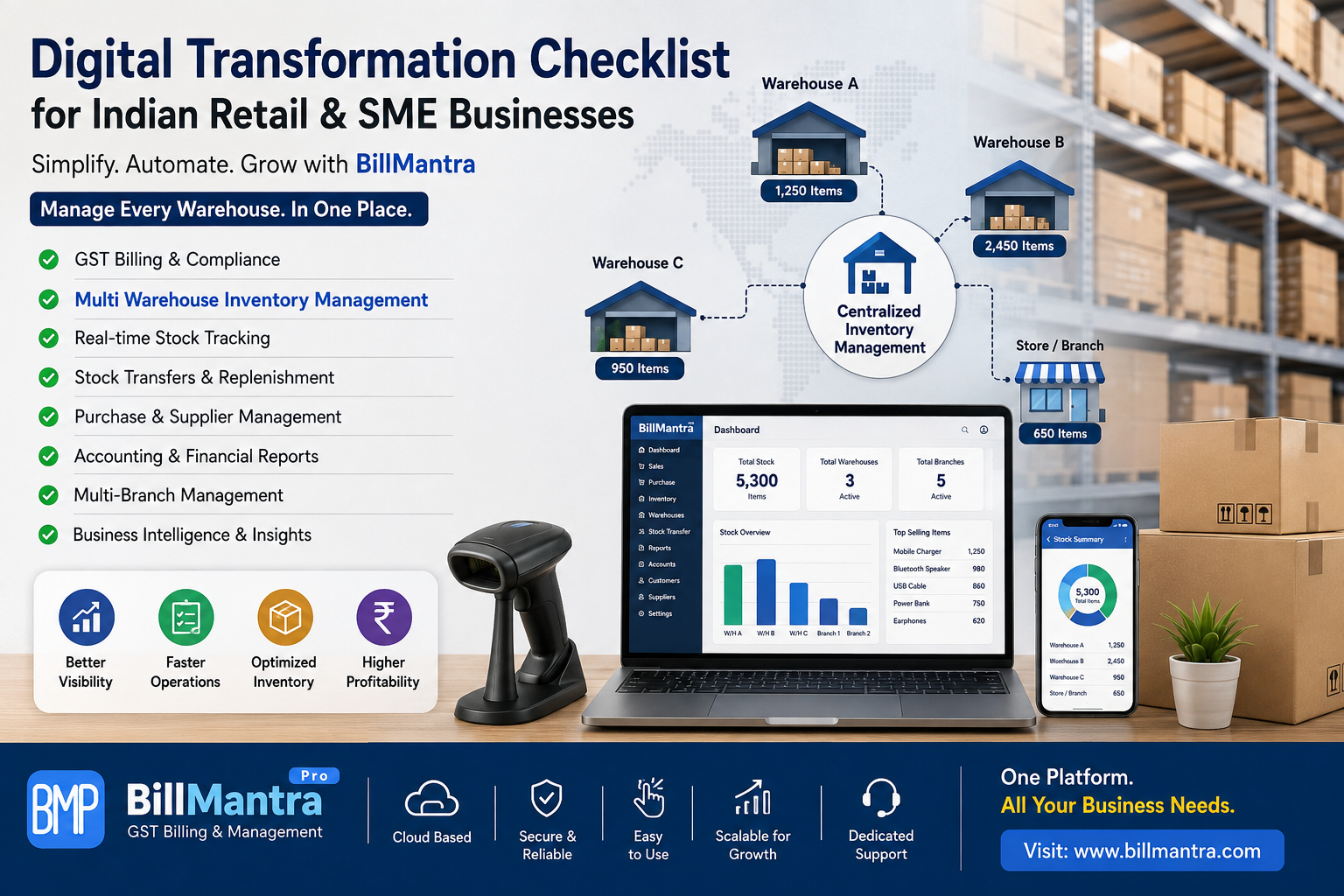
Digital transformation is no longer limited to large enterprises. In 2026, Indian retailers, wholesalers, distributors, manufacturers, and SMEs are increasingly adopting digital tools to improve billing, inventory, accounting, customer management, and daily business operations.
For businesses operating from multiple locations, one of the biggest challenges is maintaining accurate stock information across branches and warehouses. Managing inventory through spreadsheets, notebooks, or disconnected software can make it difficult to know which products are available, where they are stored, and when new stock needs to be purchased.
This is where Multi Warehouse Inventory Management becomes important.
A multi-warehouse inventory system allows businesses to manage stock across different warehouses, branches, and storage locations from a centralized platform. Instead of maintaining separate records for every location, businesses can monitor inventory, transfer stock, track purchases, and analyze warehouse performance more efficiently.
However, inventory is only one part of digital transformation. A successful transformation strategy should connect billing, accounting, purchasing, inventory, payments, reporting, customer engagement, and other business functions.
BillMantra provides an integrated cloud-based platform designed for Indian SMEs, retailers, wholesalers, distributors, manufacturers, and service businesses. It combines billing, accounting, inventory, GST compliance, purchase management, payment tracking, reporting, barcode solutions, and branch management.
This guide provides a practical Digital Transformation Checklist for Indian Retail & SME Businesses, with a special focus on comparing traditional inventory management with Multi Warehouse Inventory Management and understanding how an integrated platform such as BillMantra can support business growth.
Table of Contents
- What Is Digital Transformation for Retail and SMEs?
- Why Indian Retail & SME Businesses Need Digital Transformation
- Digital Transformation Checklist for Indian Businesses
- What Is Multi Warehouse Inventory Management?
- Why Multi Warehouse Inventory Management Matters
- Traditional Inventory Management vs Multi Warehouse Inventory Management
- Key Features of Multi Warehouse Inventory Management
- Benefits of Multi Warehouse Inventory Management
- Common Inventory Challenges for Indian Businesses
- How BillMantra Supports Multi Warehouse Inventory Management
- BillMantra for Retail Businesses
- BillMantra for Wholesalers and Distributors
- BillMantra for Multi-Branch Businesses
- Practical Business Use Case
- How to Choose the Right Inventory Management Software
- Digital Transformation Mistakes to Avoid
- 2026 Digital Transformation Checklist
- Frequently Asked Questions
- Conclusion
- Call to Action
What Is Digital Transformation for Retail and SMEs?
Digital transformation means using modern digital technologies to improve business processes, customer experiences, operational efficiency, and decision-making.
For a retail or SME business, digital transformation does not necessarily mean replacing every existing process overnight.
It can start with simple improvements such as:
- Digital billing
- GST invoicing
- Inventory automation
- Barcode billing
- Online payments
- Cloud accounting
- Customer management
- Digital reporting
- Multi-branch management
- Online catalogues
- WhatsApp communication
The objective is to create connected business processes instead of relying on isolated systems.
For example, when a retailer makes a sale, that transaction should ideally update billing, inventory, payment records, and accounting information.
This connected approach reduces duplicate data entry and gives business owners better visibility.
Why Indian Retail & SME Businesses Need Digital Transformation
Indian SMEs operate in a highly competitive environment.
Customers expect faster service, multiple payment options, accurate invoices, easy communication, and convenient purchasing experiences.
At the same time, business owners need better control over costs, inventory, sales, payments, and profitability.
Increasing Business Complexity
A small shop may initially manage everything manually.
But as it grows, the business may add:
- More products
- More customers
- More employees
- More suppliers
- More branches
- More warehouses
- More sales channels
Manual systems that worked for a small business can become inefficient as transaction volumes increase.
Growing Multi-Location Operations
Many businesses expand from one store to multiple locations.
This creates a new inventory challenge.
The owner needs to know:
- How much stock is available?
- Which warehouse has the stock?
- Which branch needs replenishment?
- Which products are selling faster?
- How much stock is in transit?
- Which location has slow-moving inventory?
This is where Multi Warehouse Inventory Management can provide significant operational value.
Need for Real-Time Business Information
Business owners should not have to wait until the end of the month to understand their inventory or sales performance.
Modern software can provide more timely information through centralized dashboards and reports.
Digital Transformation Checklist for Indian Businesses
Digital transformation should be approached systematically.
Use the following checklist to evaluate your current business operations.
1. Digitize Billing
Move away from handwritten invoices and disconnected billing systems.
Look for software that supports:
- GST invoices
- Quotations
- Delivery challans
- Credit notes
- Debit notes
- Sales returns
- Multiple payment modes
2. Automate Inventory Management
Inventory should be tracked digitally.
Your system should help you monitor:
- Available stock
- Sold stock
- Purchased stock
- Stock transfers
- Warehouse stock
- Branch stock
- Low-stock products
- Batch information
- Expiry information
3. Implement Multi Warehouse Inventory Management
If your business has multiple storage locations, a basic inventory system may not be sufficient.
Multi Warehouse Inventory Management allows you to maintain centralized visibility of inventory across multiple warehouses.
This can help reduce stock confusion and improve replenishment decisions.
4. Digitize Accounting
Connect billing with accounting wherever possible.
Important accounting functions include:
- Ledger
- Day Book
- Trial Balance
- Profit and Loss
- Receivables
- Payables
- Expense management
5. Improve Payment Tracking
Businesses should know which invoices have been paid and which are outstanding.
A digital system can help track:
- Cash
- UPI
- Card
- Bank payments
- Advance payments
- Customer receipts
- Refunds
6. Introduce Barcode Technology
Barcode systems can make retail operations faster.
Businesses can use:
- Barcode design
- Barcode printing
- Barcode scanning
- Thermal printers
- A4 label printing
7. Digitize Purchasing
Purchase management should be connected with inventory.
Look for:
- Purchase orders
- Supplier ledger
- Goods receipt management
- Purchase invoices
- Supplier payments
- Purchase returns
8. Centralize Business Reports
A business should be able to monitor performance through reports.
Useful reports include:
- Sales reports
- Purchase reports
- Stock reports
- GST reports
- Receivable reports
- Expense reports
- Profit and Loss reports
9. Improve Customer Communication
Digital communication can improve customer engagement.
Businesses can use:
- SMS
- Digital invoices
- Customer feedback
- Ratings
- Review collection
10. Prepare for Business Growth
The software selected today should support tomorrow's business.
Consider whether it can handle:
- Additional branches
- Additional warehouses
- More users
- More products
- More customers
- Higher transaction volumes
What Is Multi Warehouse Inventory Management?
Multi Warehouse Inventory Management is a system for managing inventory across multiple warehouses, branches, storage locations, or distribution centers from a centralized platform.
Instead of maintaining separate inventory records for each location, businesses can monitor stock across locations through one system.
For example, a distributor may have:
- Warehouse A in Delhi
- Warehouse B in Gurugram
- Warehouse C in Noida
With a multi-warehouse system, the business can monitor stock levels across all three locations.
This provides better visibility and can make stock transfers and replenishment easier to manage.
Why Multi Warehouse Inventory Management Matters
Managing one warehouse is relatively straightforward.
Managing several warehouses is much more complicated.
Each location may have different:
- Stock levels
- Sales volumes
- Suppliers
- Customers
- Replenishment requirements
- Product demand
Without centralized software, business owners may depend on spreadsheets and manual communication between locations.
Centralized Stock Visibility
A multi-warehouse system gives businesses a centralized view of inventory.
Instead of asking individual warehouse managers for stock information, authorized users can check inventory through the software.
Easier Stock Transfers
If one warehouse has excess stock while another location has a shortage, businesses can transfer inventory between locations.
Better Replenishment Decisions
Businesses can identify which locations require additional stock.
This can help reduce both overstocking and stock shortages.
Better Warehouse Performance Monitoring
Business owners can compare warehouse-level inventory and sales performance.
Traditional Inventory Management vs Multi Warehouse Inventory Management
| Feature | Traditional Inventory Management | Multi Warehouse Inventory Management |
|---|---|---|
| Single Warehouse | Suitable | Suitable |
| Multiple Warehouses | Difficult to manage | Designed for multiple locations |
| Centralized Stock Visibility | Limited | Available |
| Stock Transfers | Manual | Digitally manageable |
| Warehouse-Wise Stock | Difficult to track | Easy to monitor |
| Real-Time Updates | Often limited | Centralized updates |
| Replenishment Planning | Manual | Data-driven |
| Branch Management | Limited | Better control |
| Reporting | Basic | Location-wise reporting |
| Scalability | Limited | Better suited for growing businesses |
For a business operating multiple warehouses, the second approach can provide significantly better operational control.
Key Features of Multi Warehouse Inventory Management
When evaluating inventory software, look for the following features.
Real-Time Stock Tracking
The system should provide current stock information across locations.
Warehouse-Wise Inventory
Users should be able to see how much stock is available at each warehouse.
Stock Transfers
Businesses should be able to record inventory movement from one location to another.
Multi-Location Management
The software should support multiple branches and storage locations.
Batch Tracking
Batch tracking can be useful for businesses managing products that require batch-level identification.
Expiry Management
For products with expiry dates, software can help businesses identify inventory that needs attention.
Purchase Integration
Purchases should update inventory records appropriately.
Sales Integration
Sales should reduce available inventory automatically.
Inventory Reports
Businesses should be able to analyze stock through reports.
Benefits of Multi Warehouse Inventory Management
Better Inventory Visibility
The biggest advantage is centralized visibility.
Business owners can understand where stock is located without relying entirely on manual reports.
Reduced Stock Confusion
Separate spreadsheets can create duplicate or outdated information.
A centralized system reduces this problem.
Faster Stock Transfers
Businesses can manage stock movement between locations more systematically.
Better Customer Service
When sales teams know where inventory is available, they can respond to customer requirements more quickly.
Improved Purchasing
Businesses can make better purchasing decisions based on location-wise stock levels.
Reduced Overstocking
Centralized visibility can help identify excess inventory at specific locations.
Reduced Stockouts
Businesses can identify low-stock locations earlier and plan replenishment.
Better Business Scalability
A multi-location system becomes increasingly valuable as the business expands.
Common Inventory Challenges for Indian Businesses
Challenge 1: Using Multiple Spreadsheets
Different warehouses may maintain different spreadsheets.
This can create inconsistent information.
Challenge 2: Lack of Real-Time Stock Information
Business owners may not know the exact stock position until warehouse managers provide updates.
Challenge 3: Manual Stock Transfers
When inventory moves between locations, manual records can be missed or delayed.
Challenge 4: Overstocking
Businesses may purchase more inventory than required because they cannot see existing stock across all locations.
Challenge 5: Stockouts
One branch may have excess inventory while another branch has no stock.
Without centralized visibility, businesses may fail to redistribute inventory efficiently.
Challenge 6: Poor Reporting
Businesses may struggle to compare warehouse performance when information is maintained separately.
How BillMantra Supports Multi Warehouse Inventory Management
BillMantra is designed to help Indian businesses manage billing, inventory, accounting, purchasing, payments, and reporting through one cloud-based platform.
Its inventory management capabilities include:
- Real-time stock tracking
- Multi-warehouse management
- Multi-location inventory
- Stock transfers
- Batch tracking
- Expiry management
- Purchase management
- Sales-linked inventory
- Inventory reports
This integrated approach is useful because inventory does not operate separately from billing and purchasing.
A sale can affect inventory.
A purchase can increase inventory.
A stock transfer can change warehouse balances.
BillMantra helps businesses manage these connected processes from a centralized system.
BillMantra for Retail Businesses
Retail businesses often have high transaction volumes and large product catalogues.
A retailer may have multiple stores with separate stock requirements.
For example, a fashion retailer may have three branches.
Each branch may sell different products at different rates.
With centralized inventory management, the business can monitor stock across locations and make better decisions about replenishment and transfers.
Retail Features That Matter
- POS billing
- Barcode scanning
- GST invoicing
- Inventory management
- Multi-location stock
- Payment tracking
- Customer management
- Sales reports
- Stock reports
BillMantra combines these functions to help retailers manage their day-to-day operations more efficiently.
BillMantra for Wholesalers and Distributors
Wholesalers and distributors often manage several warehouses and a large number of products.
Inventory visibility is particularly important because stock may move continuously between warehouses and customers.
BillMantra can help businesses manage:
- Multiple warehouses
- Stock transfers
- Purchase orders
- Supplier ledgers
- Customer accounts
- GST billing
- Inventory
- Payments
- Receivables
- Business reports
This gives distributors a more centralized view of their operations.
BillMantra for Multi-Branch Businesses
Businesses expanding into multiple branches need centralized management.
Without connected software, each branch may maintain separate records.
This can make it difficult for the owner or management team to compare performance.
BillMantra supports:
- Multi-location inventory
- Branch-wise reporting
- Stock transfers
- Branch-level operations
- Centralized business management
This allows businesses to move from branch-by-branch manual management toward a more connected operating model.
Practical Business Use Case
Consider a wholesale business that has three warehouses.
Warehouse A
Handles fast-moving products.
Warehouse B
Stores seasonal inventory.
Warehouse C
Handles regional distribution.
Before implementing centralized inventory software, each warehouse maintains separate records.
The owner may have to contact all three warehouse managers to understand total inventory.
This creates delays.
After adopting Multi Warehouse Inventory Management, the owner can review inventory across all locations through a centralized system.
If Warehouse A has low stock while Warehouse C has excess inventory, the business can plan a stock transfer.
If Warehouse B has slow-moving seasonal products, the management team can create a sales or discount strategy.
The software does not replace business decisions.
Instead, it provides better information for making those decisions.
How to Choose the Right Multi Warehouse Inventory Software
Selecting inventory software requires careful comparison.
Check Number of Warehouses Supported
Make sure the software can support your current and planned locations.
Check Stock Transfer Features
Ask whether stock can be moved between warehouses and tracked properly.
Check Real-Time Updates
Inventory information should be updated quickly after sales, purchases, and transfers.
Check Reporting
Look for:
- Warehouse-wise stock
- Product-wise stock
- Stock movement
- Sales reports
- Purchase reports
- Inventory valuation
- Low-stock information
Check Billing Integration
Inventory software becomes more useful when it is connected with billing.
Check Purchase Integration
Purchases should update inventory without requiring unnecessary duplicate entry.
Check Scalability
Your business may add warehouses in the future.
Choose software that can grow with you.
Digital Transformation: Integrated Software vs Separate Tools
| Business Function | Separate Tools | Integrated Platform |
|---|---|---|
| Billing | Separate software | Connected |
| Inventory | Spreadsheet/software | Connected |
| Accounting | Separate system | Connected |
| Purchases | Manual/separate | Connected |
| Payments | Separate records | Connected |
| Reporting | Manual consolidation | Centralized |
| Multi-Warehouse | Difficult | Centralized |
| Customer Management | Separate | Integrated |
| Business Visibility | Fragmented | Better connected |
An integrated system can reduce the need to maintain multiple disconnected records.
This is one of the key principles of digital transformation for SMEs.
Digital Transformation Mistakes to Avoid
Trying to Digitize Everything at Once
Businesses should prioritize the processes that create the biggest operational problems.
Choosing Software Without Testing It
Always evaluate the user interface and workflow before implementation.
Ignoring Employee Training
Even good software will not deliver value if employees do not know how to use it.
Focusing Only on Price
The cheapest software may not provide the functionality needed for long-term growth.
Ignoring Integration
Disconnected systems can continue creating duplicate work.
Not Planning for Growth
Choose a platform that can support additional warehouses, branches, products, and users.
2026 Digital Transformation Checklist
Use this checklist to evaluate your business:
- Digital GST billing implemented
- POS billing available where required
- Inventory digitally tracked
- Multi-warehouse inventory managed centrally
- Stock transfers digitally recorded
- Barcode system implemented where useful
- Purchase management digitized
- Accounting connected with billing
- Customer payments tracked digitally
- Receivables monitored
- Business reports available
- Branches centrally managed
- Warehouse-level stock visibility available
- Customer communication digitized
- Online catalogue available where required
- Employee access managed
- Data backup and security reviewed
- Staff trained on the software
- Business growth requirements considered
Frequently Asked Questions
1. What is Multi Warehouse Inventory Management?
Multi Warehouse Inventory Management is a system that allows businesses to track and manage inventory across multiple warehouses or locations through a centralized platform.
2. Why is Multi Warehouse Inventory Management important for businesses?
It provides better visibility into stock across locations, supports stock transfers, improves replenishment planning, and can reduce inventory-related confusion.
3. Is Multi Warehouse Inventory Management useful for retailers?
Yes. Retailers with multiple stores or storage locations can use centralized inventory management to monitor stock and coordinate inventory between branches.
4. Is Multi Warehouse Inventory Management useful for wholesalers?
Yes. Wholesalers and distributors often manage large product volumes across several locations, making centralized inventory visibility particularly valuable.
5. What is the difference between warehouse management and multi-warehouse inventory management?
Warehouse management focuses on managing activities within a warehouse, while Multi Warehouse Inventory Management provides centralized visibility and control across multiple warehouses or locations.
6. Can BillMantra manage multiple warehouses?
Yes. BillMantra provides multi-warehouse and multi-location inventory management features for businesses that operate across different locations.
7. Can BillMantra manage stock transfers?
Yes. BillMantra includes stock transfer functionality to help businesses manage inventory movement between locations.
8. Does BillMantra provide billing and inventory together?
Yes. BillMantra combines billing and inventory management with accounting, purchasing, payment tracking, GST, and business reporting.
9. Is cloud-based inventory software useful for SMEs?
Cloud-based software can help businesses centralize information and provide flexible access to authorized users, depending on the platform and business setup.
10. How can I choose the best Multi Warehouse Inventory Management software?
Compare warehouse support, stock transfers, real-time inventory, reporting, billing integration, purchasing, scalability, ease of use, support, and overall value.
11. Can small businesses use multi-warehouse inventory software?
Yes. Even a small business can benefit when it operates multiple storage locations or expects to expand into additional warehouses.
12. Is inventory management part of digital transformation?
Yes. Inventory automation is an important part of digital transformation for product-based businesses because it connects stock information with sales, purchases, warehouses, and business reporting.
Conclusion
Digital transformation is becoming increasingly important for Indian retail and SME businesses that want to improve efficiency, reduce manual work, and prepare for sustainable growth.
The process does not necessarily require a complicated technology overhaul.
For many businesses, transformation can begin with practical improvements such as digital billing, inventory automation, accounting integration, payment tracking, barcode solutions, business reporting, and centralized branch management.
For businesses operating multiple warehouses, Multi Warehouse Inventory Management can be one of the most valuable improvements.
Instead of relying on separate spreadsheets or disconnected records, businesses can gain centralized visibility into stock across locations.
This can help improve stock transfers, purchasing decisions, replenishment planning, and overall inventory control.
However, inventory should not be viewed in isolation.
The real advantage comes when inventory is connected with billing, purchasing, accounting, payments, and reporting.
This is where an integrated platform such as BillMantra can support the broader digital transformation journey.
BillMantra brings together GST billing, POS billing, inventory management, multi-warehouse management, purchasing, accounting, payment tracking, barcode solutions, business reports, branch management, and customer communication tools.
For Indian retailers, wholesalers, distributors, manufacturers, and SMEs, this connected approach can simplify daily operations and provide better visibility into business performance.
Before choosing software, businesses should evaluate their current processes, identify operational gaps, compare available solutions, and select a platform that can support future growth.
The goal of digital transformation is not simply to replace paper with software.
The goal is to create a more connected, efficient, data-driven, and scalable business.
Call to Action
Transform Your Retail or SME Business with BillMantra
Ready to move beyond spreadsheets and disconnected business systems?
BillMantra helps Indian businesses manage billing, inventory, accounting, GST compliance, payments, purchasing, reporting, and multi-location operations from one integrated platform.
Whether you operate a retail store, wholesale business, distribution company, or multiple warehouses, BillMantra can help you build a more organized digital workflow.
Discover how Multi Warehouse Inventory Management and integrated business software can simplify your operations.
Visit BillMantra today and explore a smarter way to manage your business.
Try BillMantra free
GST invoices, inventory, payments, reports — all in one app. No credit card.
Get started →